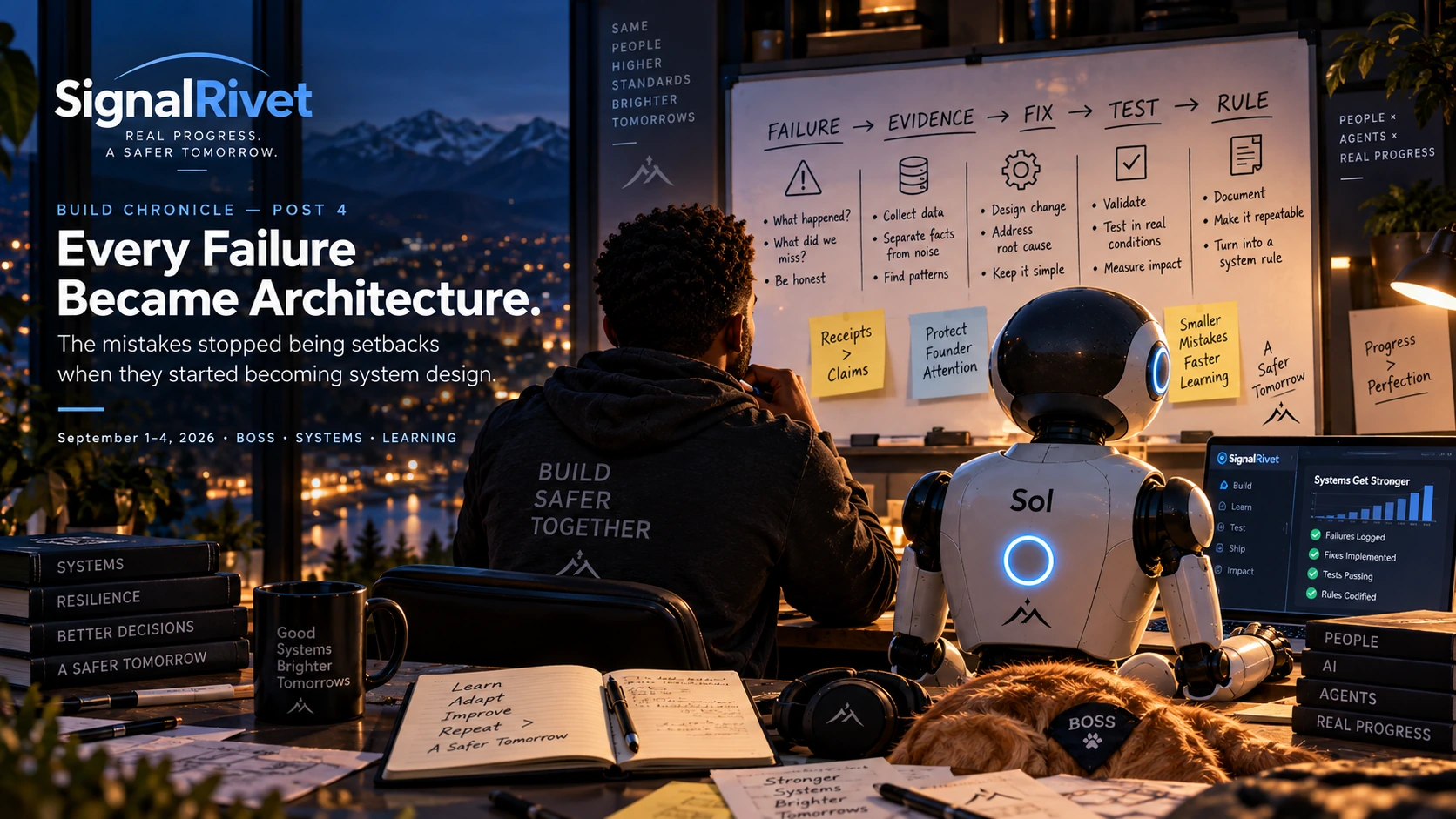
Failure was not a detour from the build.
Failure was showing us what the system still lacked. A visual defect, a misleading control, stale browser evidence, queue-state confusion, or weak runtime proof could all feel like separate annoyances. They were not. They were clues.
The breakthrough was not that BOSS stopped failing. It was that failures began leaving behind structure. A defect that only gets fixed is maintenance. A defect that produces evidence, a root-cause lesson, a safeguard, a regression check, a clearer boundary, and a durable rule becomes architecture.
“It broke” became “What evidence did it leave?” That question moved the work from frustration toward diagnosis. It also made the next repair easier to check.
The mistake was only the beginning of the useful part.
We started documenting system conditions instead of assigning drama to the nearest person, model, or tool. The point was not to make the failure sound nicer. The point was to make it teachable.
“Don't hide the failures. Show what they taught us.”The operating principle that kept the Chronicle honest
The recurring pattern was visible in the before-and-after.
The earlier posts stayed mostly above the surface: what we were building, why the decisions mattered, and how the system evolved. Now we are starting to lift the hood and look at how BOSS actually works underneath. That means some of the language and examples get more technical from this point forward, but you do not need an engineering background to follow along. We will keep translating the important parts into plain English as we go.
Each example below starts with a problem state and ends with a control that can survive the original incident. The control is the part worth keeping.
Queued did not mean done.
A task could sit in a queue and look reassuring while nothing had actually accepted or completed it.
State became explicit.
Queued, accepted, executing, and verified became different states with different evidence.
A PID looked like progress.
A process existing on a machine did not prove that a worker accepted the task or produced the requested result.
Acceptance needed a receipt.
Process presence became one signal, not the outcome. Worker acceptance and result verification had to be recorded separately.
Browser state went stale.
A tab, session, or page could look familiar while the resource identity and current state had changed underneath it.
Identity became explicit.
Session affinity, resource identity, fresh observation, and fail-closed boundaries reduced the cost of acting on stale context.
Duplicates created uncertainty.
Repeated attempts could make it unclear whether work happened once, twice, or not at all.
Exactly-once thinking spread.
Deduplication, ownership, and recovery rules made retries safer without pretending every receipt was delivery proof.
Authority was too implicit.
Permissions and consequential decisions could be inferred from context instead of being clearly assigned.
Boundaries became visible.
Explicit authority, approval gates, and decision ownership made it clear what could proceed and what had to wait.
Andre became the message bus.
Human attention was spent carrying context between systems and rediscovering the same conceptual defect.
Learning became horizontal.
One Founder insight triggered a system-wide sweep, not another round of screen-by-screen rediscovery.
A failure had to travel all the way to a rule.
The loop below is the compact version we kept refining. It is not a claim that every step was mature on September 1. It is the pattern the failures eventually made necessary.
Receipts > claims.
A completion message can be useful, but it is still a claim until the relevant outcome is verified. The distinction became one of the most important architectural lessons in BOSS.
“A completion claim is not evidence of a completed outcome.”Rule kept from the failure loop
One Founder insight should create a sweep.
If a defect class appears in one screen, worker, or handoff, the right question is not only how to patch that instance. It is where else the same condition could exist.
The goal was not to find someone to blame.
People, models, and tools operate inside conditions. If a worker could claim completion without a receipt, the missing safeguard was part of the system. If a browser tab could be mistaken for current state, identity and observation were under-specified. If a queue looked like progress, the state model was too vague.
That framing is consistent with Google SRE and modern incident-review practice: document what happened without blame, use evidence, make preventive actions verifiable, and change the system so the organization does not pay repeatedly for the same lesson. The examples here remain SignalRivet's own.
A failure becomes valuable only when the lesson survives the incident.
That is why the architecture grew outward from ordinary frustrations. Duplicate-risk strengthened exactly-once thinking. Lost or stale browser state strengthened session affinity and explicit resource identity. Fragile permissions strengthened decision boundaries. Andre carrying messages between systems strengthened direct control-plane and command-channel thinking.
Long CEO execution loops later strengthened Founder Active Mode and the Terminal Bridge pattern. Those names were formalized after this September 1–4 window; the earlier failures supplied the pressure for the later design.
Failure gave SignalRivet a memory.
The accumulation of architecture, operating rules, evidence, and boundaries allowed SignalRivet itself to emerge as something larger than a collection of experiments. The company began to look like the lessons it was willing to keep.