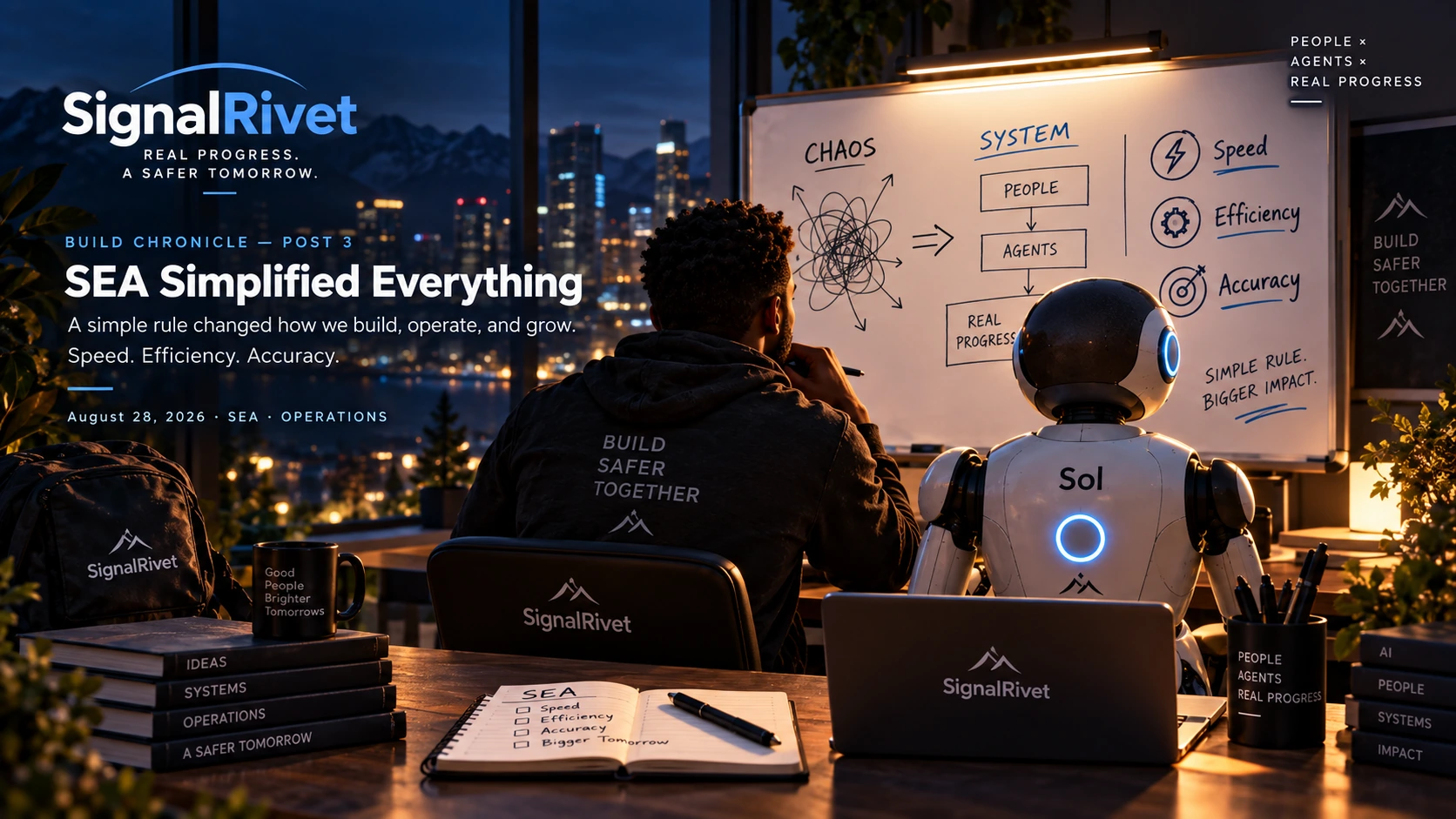
Complexity became the new enemy.
Post 1 gave us a direction. Post 2 showed us that a capable agent was not, by itself, a reliable operating system. Then BOSS accumulated the things a real system needs: workers, tools, state, memory, handoffs, checks, and more ways to make a choice.
That was progress. It was also a new kind of problem. Every new capability created another possible path. We could reason through each choice from scratch, but that made simple work feel heavy and made difficult work harder to see clearly. We did not need another tool. We needed a way to choose.
Post 2 had shown the Founder becoming a message bus. Speed was not asking every worker to run faster. It meant protecting scarce human attention and reducing handoffs that existed only because the next decision was unclear.
And the commercial reality stayed candid: verified revenue was still $0. SEA was partly a way to spend scarce attention, compute, and effort intelligently. It was not permission to build internal machinery forever.
“Same goal. Fewer steps. Better results.”The operating instinct behind SEA
Three words made the next decision easier to see.
Andre coined SEA on August 28, 2026: Speed. Efficiency. Accuracy. It was not a day-one philosophy that had always existed. It arrived after the system had become harder to reason about, and it gave that growing complexity a small rule.
Safety / authority → accuracy → efficiency → speed. A fast action that is unauthorized is not a successful action. A cheap answer that is wrong is not efficient. A correct result without proof is not yet trustworthy. Safe independent work may move in parallel; an external, consequential, or Founder-gated action waits for the right authority.
The words are ordinary on purpose. Their job was not to sound like a polished framework. Their job was to be usable in the middle of real work, where speed had to remain constrained by authority and proof.
Speed
Reach the fastest useful outcome. Shorten the distance between a question and a result by removing unnecessary waiting and handoffs.
- Shorter problem-to-result cycles
- Parallel work only where safe and independent
- Evidence prevents slow rework
Efficiency
Use less waste and the least expensive sufficient resource. Reuse what already works; automate repetition instead of paying to rethink it.
- Reuse proven systems and helpers
- Cheaper resources for repetition
- Deterministic tools for deterministic work
Accuracy
Make the result correct, reliable, evidence-supported, and reproducible enough to trust. A fast wrong answer is still wrong.
- Verify current state
- Keep evidence and receipts
- Escalate when confidence is not enough
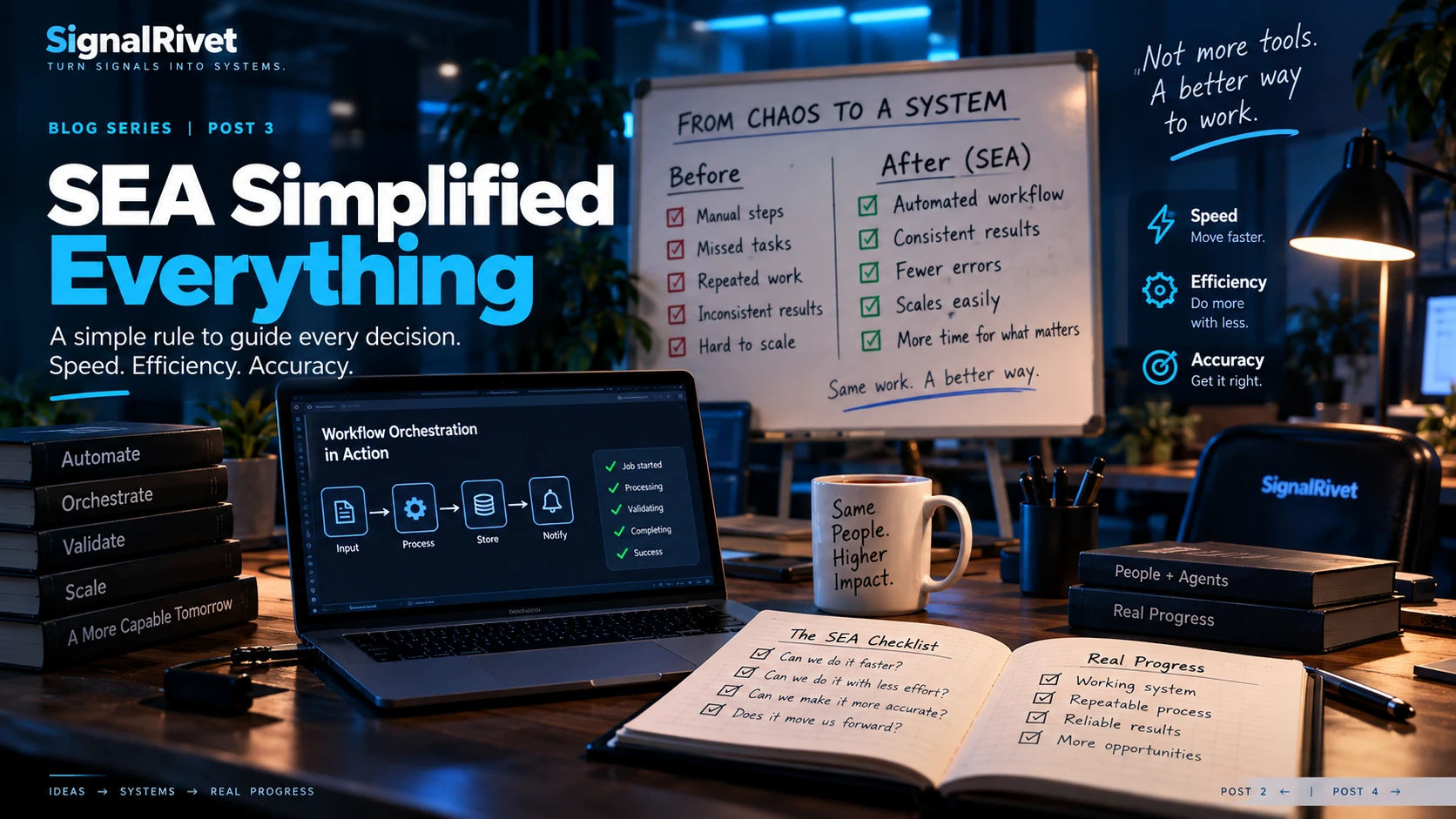
SEA was a filter, not a finish line.
It did not promise that every task would be easy. It gave us a repeatable first question: what is the least complicated path that gets us to a useful, trustworthy outcome?
Use judgment where ambiguity lives.
SEA pushed us toward a simple division of labor. AI is useful for ambiguity, interpretation, judgment, planning, and synthesis. Ordinary software and Python are better at state, IDs, comparisons, arithmetic, permissions, validation, deduplication, and repeatable helpers.
AI for ambiguity
- Interpret messy language
- Plan and synthesize
- Handle novel judgment calls
Software for certainty
- Track state and IDs
- Compare, calculate, deduplicate
- Validate repeatable conditions
Inspect and reuse an existing helper first. Let deterministic software compare IDs or state. Reserve deeper reasoning for the ambiguous choice. A consequential external step waits for authority and review.
Reason deeply once. Then stop paying for the same thought.
This is a later synthesis of what SEA made visible, not a claim that the final pattern existed fully formed on August 28. The useful loop was:
The order matters.
SEA is not three independent slogans. It is constrained optimization: safety / authority → accuracy → efficiency → speed. Evidence belongs in that sequence because it prevents rework and false completion.
A faster wrong answer is still wrong.SEA is speed with a brake pedal
A simple filter changed more than the wording.
Over time, SEA gave us a way to shape architecture: route ambiguous work to intelligence, use deterministic-first helpers for predictable work, clarify what each worker owned, reduce repeated decisions, and require evidence-based completion. It did not eliminate failure, make BOSS scalable by assertion, or prove production or customer outcomes. It made the next decision clearer.

Every Failure Became Architecture.
SEA clarified the decisions. It did not make failure disappear, simplify away the underlying complexity, or finish the business. The next breakthrough was recognizing that each failure could become a stronger handoff, boundary, check, or recovery path.