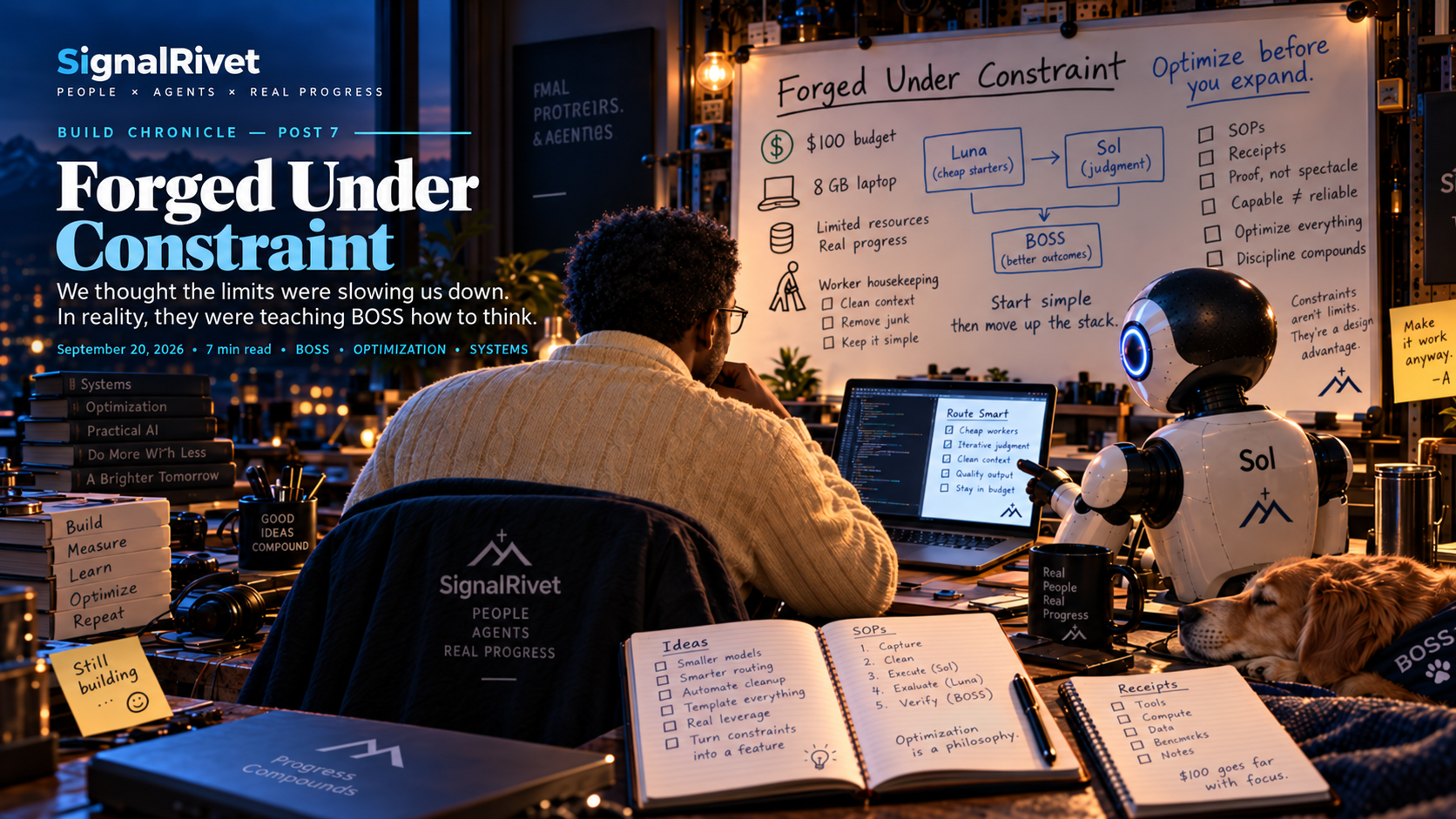
By September 20, BOSS had existed for only twenty-five days. It felt older because those days were dense: workers, failures, SOPs, browser problems, website rebuilds, routing rules, receipts, continuity work, and one correction after another. Underneath all of it was a constraint we could never ignore: we could not buy our way out of hard problems.
BOSS was not born in a well-funded lab. It was being built on an 8 GB laptop, under a tiny operating budget, while every dollar, API call, process, browser tab, and worker had to justify its existence.
The constraint was not temporary background noise.
It shaped the architecture.
If we had started with abundant money, the easiest answer to a slow process might have been more compute. The easiest answer to a missing capability might have been another SaaS subscription. The easiest answer to operational friction might have been another person, another service, or a larger API budget.
We did not have those escape hatches. So the question kept changing from what can we buy? to what can we make work better?
Scarcity made waste visible.
On a powerful machine, sloppy resource use can hide for a long time. A few unnecessary processes barely matter. A heavyweight tool for a lightweight job still finishes. A model that is more expensive than necessary still produces an answer. Nobody notices the cost until the system gets large enough for waste to become expensive.
On our machine, waste announced itself immediately.
What scarcity exposed
- ✓Workers that were left running too long.
- ✓Browser processes that quietly ate memory.
- ✓Tasks routed to more model than they needed.
- ✓Repeated work that should have been stored once.
What we learned to do
- 1Clean up aggressively.
- 2Keep durable state outside the model.
- 3Use the cheapest reliable path.
- 4Escalate only when the task earns it.
Housekeeping stopped being a maintenance chore and became an operating discipline. We learned to kill stray processes, reuse what was already available, preserve evidence instead of recomputing it, and keep the active working set small.
The laptop was teaching us a lesson that looked suspiciously like good systems design: capacity is not permission to waste capacity.
The budget changed how we used intelligence.
Model routing became part of the same lesson. The most capable model was not automatically the right model for every task. Some work was repetitive, bounded, and cheap to delegate. Other work needed judgment, synthesis, or a stronger understanding of the larger system.
That split eventually became one of the clearest ideas inside BOSS: expensive judgment should be scarce. Cheap execution should be abundant. Durable state should live somewhere that does not need to be reinvented every time.
What began as a financial necessity started looking like architecture we would want even if the budget became much larger.
Then we noticed the O.
BOSS stands for Business Optimization & Strategy System. For a while, we spent so much time making the system reliable that we had quietly underused one of the most important words in its own name.
Optimization was already everywhere in the way we worked. We just had not centered it.
We were constantly asking whether something could be eliminated before it was automated, simplified before it was rebuilt, reused before it was replaced, or handled with existing resources before new money was spent.
That realization changed the customer-facing story too. SignalRivet should not begin with software. It should begin with the system the customer already has.
The strange part is that this transfers directly to customers.
Small businesses live inside constraints every day. They cannot always hire another person. They cannot buy every premium platform. They cannot rebuild every process from scratch. And they do not need a consultant whose first instinct is to increase the size of the solution.
Our own operating environment has made that problem feel familiar.
When a customer says, “We cannot afford another employee,” the useful response is not automatically “then buy software.” It is to understand the work first. Maybe part of the work should disappear. Maybe the handoff is the real problem. Maybe two tools are doing the same job. Maybe a repetitive step can be automated cheaply. Maybe the staff they already have could do more useful work if the process stopped fighting them.
Lesson we kept
Optimization is not squeezing more work out of people. It is reducing the amount of wasted effort surrounding useful work. Use what already exists. Remove what does not need to exist. Simplify what remains. Automate only where it earns its place. Add cost last.
The laptop became part of the story.
There is something funny about imagining a future version of BOSS running on powerful hardware, with a real operating budget, looking back at the machine that raised it.
The original laptop has only 8 GB of RAM. Its battery has failed badly enough that unplugging it can end the session immediately. It has spent much of this build being asked to run a browser, development servers, workers, local processes, tools, and whatever else we could carefully fit into the same small box.
Someday it will stop working completely.
We are keeping it.
Not because a dead laptop is useful hardware, but because it will still be useful history. It is a physical reminder that BOSS did not learn resource discipline in theory. It learned under pressure.
Forged on a $100 budget and an 8 GB laptop. If the system eventually has vastly more money and compute, the goal is not to forget scarcity. The goal is to keep the habits scarcity taught us.
Twenty-five days in, the pace looks different.
The lack of revenue still matters. Mission $20 exists because useful work eventually has to survive contact with a real customer and a real payment. But twenty-five days is also twenty-five days.
The density of the work can make the project feel months old. Chronologically, it is barely more than three weeks.
That changes the interpretation. Zero revenue at day twenty-five is a metric we have to respect. It is not evidence that the system has been standing still. In less than a month, the constraints themselves have produced better routing, stronger cleanup, better verification, tighter resource discipline, and a clearer customer promise.
What came next
The next challenge was no longer just how to make BOSS efficient. It was how to turn that efficiency outward: use the same discipline to find customers, diagnose real operational pain, and prove that optimization could create value outside our own walls.
The cave had done its job. Eventually, the thing built inside it had to walk outside.