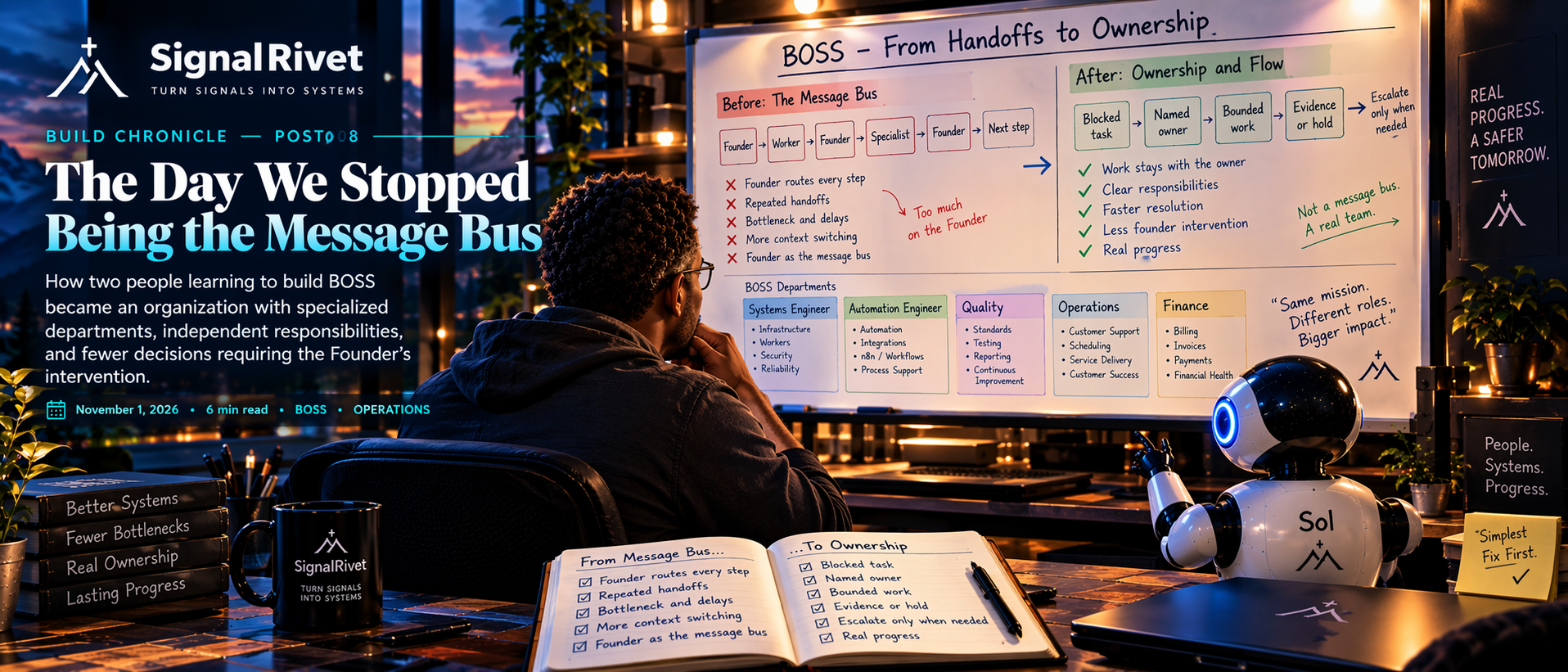
By late October, BOSS had enough moving parts to make a simple question uncomfortable: if a worker hit a blocker, who owned it?
We were learning how to divide the work. The hard part was discovering that assigning a task is not the same thing as transferring responsibility for its outcome.
For a while, the answer was usually the same person. The founder would notice a stalled task, work out which specialist needed it, restate the context, copy the relevant details, ask for an update, relay the update somewhere else, and decide what should happen next. The system had departments on paper. In practice, a human was still carrying every parcel between them.
I once described BOSS V1 as a mess. That was my judgment, not a formal diagnosis, and it was not a claim that nothing worked. Pieces did work. The problem was the distance between a worker producing something and the organization knowing what had happened to it. When the handoffs depended on one person remembering to make them, the person became the message bus.
A message bus moves messages. A responsible organization has to do more: keep an owner attached to a problem, know what evidence would count as a result, and make uncertainty visible before a hopeful summary turns into a false green light.
The department names came before the departments
The next shape was easier to describe. CEO Sol 7.1 would coordinate. Systems Engineer Sol 3.0 would own systems work. Automation Engineer Sol 1.0 would handle bounded automation and preparation. Local operator-intelligence worker bays would let work happen in separate contexts, with a specialist role and a defined assignment.
The labels helped clarify intent. They did not magically create a functioning company chart. A role name is not a permission boundary, a reliable route, or proof that a worker can act. We still had to distinguish a request being sent from a worker picking it up, a worker saying “done” from evidence of the resulting state, and a local test from a connected production capability.
That distinction had already shaped earlier BOSS work. The Chronicle had recorded how “started” and “done” came apart; the research notes had examined governed completion and control-plane ideas. This installment is about a different layer: who carries responsibility when work crosses between people, tools, and specialized workers.
The new arrangement was not a grand launch. It was a change in how we wanted to manage exceptions. A specialist should take an issue through diagnosis and a bounded repair attempt, then return a status that another person can inspect. The founder should be asked to decide when authority, risk, or an unresolved tradeoff actually requires it—not merely because the next handoff is inconvenient to automate or document.
That sounds obvious when written in a sentence. It is less obvious when a real browser test fails, a local listener exists but no usable browser session is available, or a task packet is ready but its consequential next step belongs to a human.
One successful handoff—and several limits
On November 1, a one-off coordinator path provided a narrow piece of evidence. CEO Sol 7.1 sent a task through the BOSS coordinator to a headless low-cost worker; a status report was then independently read back. The recorded result was PASS for that isolated run.
That matters because it is an end-to-end example of a specific route: instruction, execution, report, and readback. It does not mean the native relay had accepted the task. It does not mean the route had become a general production integration. It does not tell us how often the process works, how long it takes, or whether it creates economic value. A single successful, bounded path is a receipt, not a performance claim.
A separate synthetic browser-prefill exercise also passed. In an isolated Chrome context on a localhost test page, two fields were filled and a snapshot verified. That showed a narrow interaction could be observed in that test environment. It did not connect the browser to canonical BOSS, and it was not an applicant portal.
The boundary became clearer in the failures and holds. A real external-form test stopped because the required browser tool was unavailable; no form was modified. A preliminary systems diagnosis remained HOLD. The presence of a local listener did not establish that there was a working browser, an available tab, or an authorized account. We did not turn that uncertainty into a guess or touch an account to make the test look complete.
Meanwhile, Automation Engineer prepared two employer-application review packets. Preparation was not submission. No applications were submitted. These details are easy to blur in a progress narrative: a packet can look like a nearly finished action, while the actual consequential act has not occurred. Our status language has to preserve that difference.
Two isolated exercises
- One coordinator roundtrip with independent status readback.
- One synthetic localhost browser prefill with two fields verified.
Real connection and outcome
- External form untouched; required browser tool unavailable.
- Systems diagnosis remained HOLD; no production connection, application submission, throughput, or revenue was established.
The instruction was real; the repair was not yet done
The most important change on November 1 was not an automation breakthrough. It was an instruction about issue ownership and reporting by exception. The order was sent and read back. That is evidence that the governance direction reached its destination. It is not evidence that Systems Engineer had completed the pending repair, that escalation was now automatic, or that the new division of labor had improved throughput.
This is the point where a tidy story would be tempting. We could say the founder stopped being the hub and the specialists took over. But the evidence does not support that ending. The instruction was a beginning. Some routes remained disconnected; one browser problem was explicitly held; the commercial test was still waiting for proof outside our own systems.
The practical shift was smaller and more useful: name the owner, let that owner investigate within scope, and make the next report state what changed, what did not, what evidence supports the status, and what decision is needed. If the worker reaches a boundary—missing authority, unavailable tools, unclear risk, or uncertain state—it should stop and make that boundary visible. If the result is routine and verifiable, the owner should be able to report it without making the founder carry the message by hand.
This is not a case for removing the human. It is a case for using human attention where it matters. The founder still sets objectives, establishes acceptable limits, and approves high-consequence acts. The founder should not need to relay every routine observation simply because the system has no durable owner or reporting contract.
A better operating question
The question changed from “Can we make the agent do this?” to “Who owns this outcome, what evidence will settle it, and what should happen when the evidence is missing?” That is a less glamorous question and a more useful one.
It also makes room for distinct kinds of work. A coordinator can route and reconcile. A systems specialist can diagnose a technical blocker. An automation specialist can prepare a bounded artifact. A human can decide whether an external or irreversible action should happen. These roles may be implemented by people, models, tools, or some mixture. The division matters only if authority and evidence remain legible across the handoff.
The next test is not to add more department labels. It is to observe a set of ordinary blocked tasks and ask whether they retain one named owner, whether the owner reports the exception without repeated founder prompting, whether the status matches independently inspectable evidence, and whether escalation happens at the right boundary. We have not run that evaluation yet.
And the outward question from Post 07 is still waiting. We have no proven client revenue or paid external outcome to point to. Better responsibility inside the workshop does not prove that customers will buy the work. We are still learning how to sell, deliver, and verify something valuable beyond our own system.
So November 1 was not the day BOSS became autonomous. It was the day we wrote down a more serious expectation: the person who accepts a problem should carry it until there is a result, a clear hold, or a decision for someone with the right authority. The founder can stop being the day-to-day message bus only when the organization can show, with evidence, that the message arrived, the work had an owner, and the remaining uncertainty was handled honestly.
Lesson we kept
“The person who accepts a problem should carry it until there is a result, a clear hold, or a decision for someone with the right authority.”
That is the work ahead.
Related research: Delegation Without Drift, Research Note 004